Search This Blog

This is a blog about Peggy and Bob's Great Loop adventure which began in September 2008 in Lake Superior aboard "Baby Grand," their 32' Grand Banks trawler.

Wednesday, June 30, 2010

The Queen is Coming…the Queen is Coming 6-30-10


We are in Ottawa at the junction of the Ottawa River and the Rideau Canal which was built by the English to protect Canada from an invasion from the United States after the War of 1812. However, American boaters invade here every summer and our turn was on Sunday, June 27th. We climbed the flight of 8 locks with some effort as we had to fend off to protect our varnished teak rails and the townspeople welcomed us with open arms. What a difference 200 years makes in the foe vs. ally configuration! I wish we had a better picture to show you (this is from our flybridge at the top lock)…we were in about 50 photos today from people lining the walls and bridges and I should have asked one of them to take our picture.

We are no longer in French Canadian territory as you can tell from the architecture of Parliament Hill and the accompanying sound of Westminster chimes noting every ¼ hour. This is Loyalist territory and the whole town is getting ready for a visit from the Queen. Canada is a constitutional monarchy and they are still crazy about their connection to the UK and the Queen enough to spend millions for her visit here on Canada Day, July 1st . You know how you have to clean and polish everything when your mother is coming for a visit, that’s what it’s like in Ottawa this week with the Mounties practicing their steps, bagpipers blowing under bridges to test their wind power and workers even cleaning lampposts---really. We decided that we wanted to stay for Canada Day as we’ve been Minnesotans for 33 years which is practically a kissin’ cousin and it is going to be a great party. There is a lot of camaraderie here on the wall and we even met more Loopers, Jim and Linda from Selah.

We are having a great time. Ottawa is hosting a Jazz festival in Confederation Park which is located adjacent to the docking wall. George Benson is here on Wednesday, Dave Brubeck, on Saturday and I wish we had time to stay next week to finally hear Sharon Jones and the Dap-Kings. Look closely at the picture from the Peace Tower and you can see a line of boats right in the middle of town—great location for everything. We toured Parliament and the Supreme Court yesterday without advance reservations which is way less complicated than touring our capitol. So many museums (Bytown, National Gallery, Rideau Hall, War Museum, Museum of Nature, Aviation Museum, Cold War Museum, Museum of Civilization….the list is endless, and with a few rainy days, this is a good option. We did a ghost tour and learned of the spirits that frequent the Canal—does it look like there is a spirit casting a shadow next to our boat???????? How am I going to sleep tonight?????

There are plenty of places to reprovision. By Market is the oldest farmer’s market in the country and open every day, and also has great ethnic restaurants. Take the # 7, 12, 14 or 18 bus east on Rideau Ave. and you will find the Metro grocery store open 24/7 or Lablaws, open 9am to 8pm. It was laundry day again for me but less complicated at the Rideau Coin Wash at 436 Rideau also on the above bus routes. Public library at 377 Rideau has Wi-Fi, and you can also find it in the Rideau Centre Shopping Mall about 3 blocks from the dock wall. It has plenty of shops, movie complex and an LCBO store.

The big story is the Queen’s visit and I wonder what outfit she’ll be wearing and if I will get to see the famous wave. Stay tuned……….

Saturday, June 26, 2010

Highlights of Cruising the St. Lawrence and the Ottawa Rivers 6-26-10


We left the bustle of Montreal behind as we headed back to the St. Lawrence Seaway bound for the St. Lambert and St. Catherine locks. Cruising books and other boaters had warned us that there can often be a 3-4 hour wait per lock, but we really lucked out this Tuesday morning and locked right through with the tall ship, Pride of Baltimore. These locks are not on our Park Canada pass and are $25 each which is collected by the lockmaster with a shovel passed to us like a church usher with a collection basket. The Pride of Baltimore is headed to Oswego to begin a tall ship tour of the Great Lakes area.

We parted company at St. Anne de Bellevue, a charming town strategically located at the mouth of the Ottawa River. We retire Richardson's Hudson River and Adjacent Riverways Chartbook of 110 pages here—that’s a lot of traveling which began in 7/09. The Ottawa River stretches 360 miles to the west, was called the “Grand River” by native people and the voyageurs who used it, along with portages, to go all the way to the Great Lakes. The English put in the locks to protect their military and commercial endeavors. We will only be traveling 97 miles to Ottawa, the capital of Canada, and then will travel down the Rideau Canal—we love Canadian locks and towns!

St. Anne de Bellevue has room for at least 30-40 boats on 2 walls. The town has 10 waterfront restaurants, a grocery store, library with Wi-Fi, a marina store where we found charts we needed for the Thousand Islands and beer and wine at Couche Tard. McGill University Macdonald campus is here and has miles of walking and bike trails and the #211 and #251 bus stops are here to bring you into Montreal. The highlight of our stay was the French Canadian celebration of St. Jean Baptiste Day on June 24th. Pouring rain cast a pall on the daytime events, but then the sun burst through at 5 pm, the dancing, singing and partying began, capped by a fire show of twirling batons lighting the night sky.

It was time to move on to the Carillon Lock which is 65 feet high and is the largest in Canada. We decided to spend the night below the lock on the wall and found a half day of activities in town. You can visit the old lock and the restored lockmaster house which now is a museum complete with a café with friendly staff. Walk another ½ mile into town and you will find the D’Argenteuil Regional Museum which has an interesting historical collection. You can walk up the hill to meet the current lockmasters who take pride in being the “king of Canadian locks” and even gave us a bit of O Canada, the national anthem. We have met so many wonderful Canadians who are eager to share their country and it is really the people who make the memories special.

Next stop was a lunch stop at Hawksbury after locking through the Carillon on Saturday morning. Hawksbury has a welcome center, free dock with electric and in a ½ mile walk to Main Street, you can find a bakery,Le Petit Pain, a used book store and the LCBO liquor store—what else do you really need. We definitely would have spent the night but wanted to get further down the river towards Ottawa. We passed the Chateau Montebello at Milepost 42.2 but it charges $3.70 per foot and I am not sure heaven charges that much. A Canadian boater had told us about an excellent anchorage at Baie des Arcand located about ¾ mile sw of the Chateau which has at least 6 feet of depth and a priceless experience.

Wednesday, June 23, 2010

Quaint Old Quebec 6-21-10


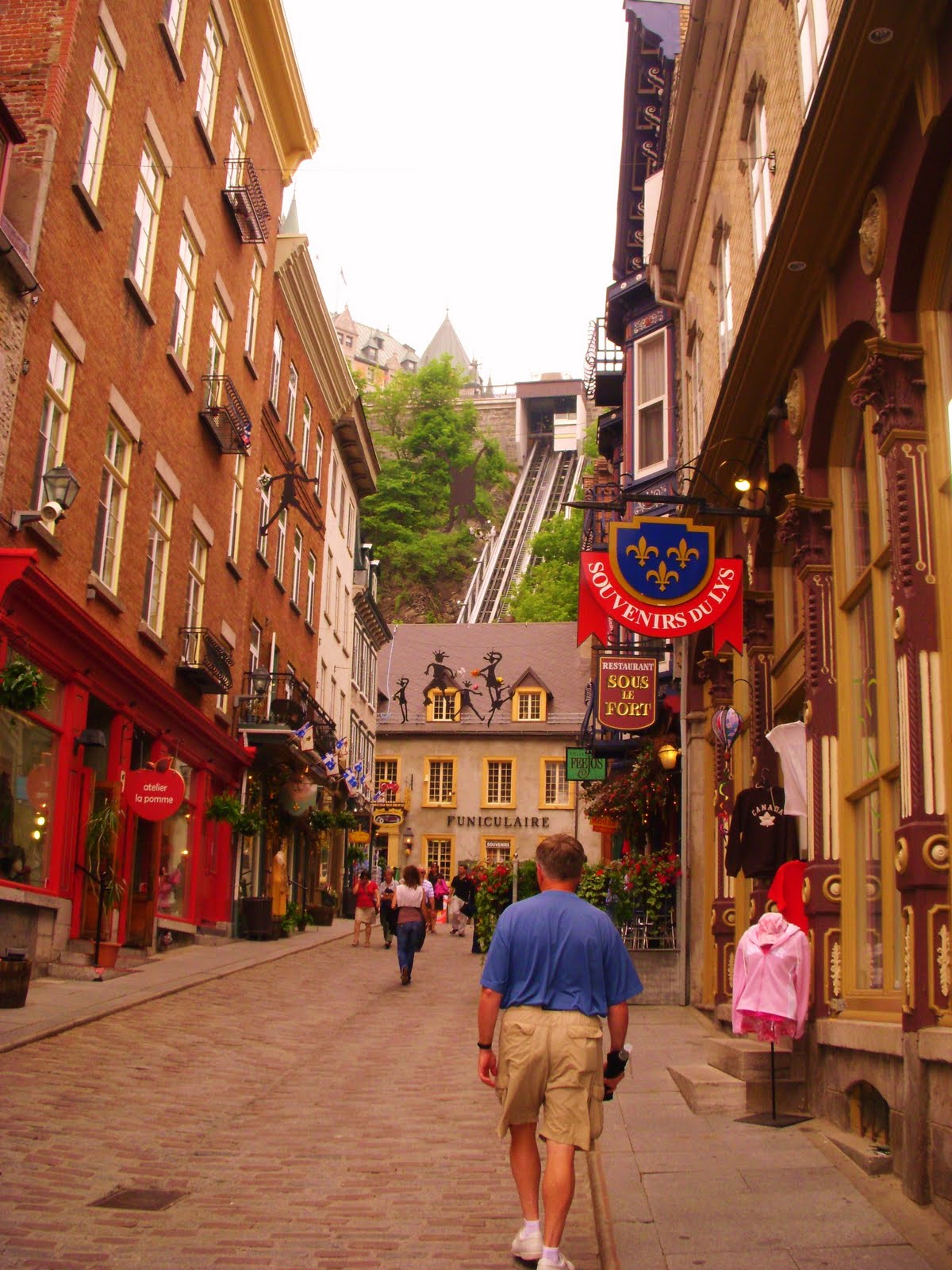
If you have the luxury of time on the Loop, consider taking the train to Quebec City for a romantic get-away. Put your nautical charts away for awhile, take a break from following the buoys and instead, tour with the aid of Frommer’s Montreal and Quebec City Guidebook. We used it to find an economical boutique hotel (Manoir Sur-le-Cap) as well as restaurant picks (Le Pain Beni for bistro French food; Aux Anciens Canadiens for traditional Quebecois; and Le Lapin Sauté for brunch). Old Quebec is a treat for your senses as you do a walking tour up and down its colorful streets decorated with ornate signs and window boxes overflowing with colorful flowers and the aromas from the outdoor cafes will entice you to check out their menu.

Expect the unexpected in this city-- a free-wheeling bike race through its hilly narrow streets, watch street performers playing with fire, listen as a carillon of bells heralds a proud Dad escorting his beautiful daughter down the aisle at the Basilica of Notre Dame, sit on a bench and people watch as you are serenaded by musicians or watch lovers of all ages strolling arm in arm.

Inclimate weather was forecast and we had museums planned, but since everyone carried an umbrella, the rain gods were bested and we stayed outside. Old Quebec has a park tucked away on every block in addition to its wide promenades (Terrasse Dufferin, Promenade des Governeurs and the waterfront area, Pointe-a-Carcy along the St. Lawrence River). The marina here has its own lock because of the 15 foot tidal swing and there is a colorful outdoor market to reprovision. You can step back in time with a tour of la Citradelle and learn how the European quest for land in this area led first the French, and then the English to fortify this strategic spot and you can now watch the changing of the Guard. We toured the opulent Chateaux Frontenac Hotel with a very entertaining guide dressed in period costume and he delighted us with gossip from yesteryear.

So much to love here…… The Quebec license plate has the phrase je me souviens or "I remember” and we will.

Marvelous Montreal 6-18-10


Even though Montreal has very long cold winters and short summers like Minneapolis/St. Paul, it has a 2 million population base in the city and a French connection that gives it a vibrancy or joie de vivre. There is always a festival going on, Cirque de Soleil sets up its tents here, and the nightspots stay open until 3am.

Old Montreal is where the city was born and is more our style. We used our Frommer’s Guidebook to outline walking tours of the cobblestoned streets, open air markets, cafes, shops, historic homes and churches. Even though Basilique Notre-Dame is resplendent in glittering blue and gold tones complete with a light show at night, we were drawn to the smaller Chapelle Notre-Dame-de-Bon-Secours, or the Sailors’ Church. Here you will find ship replicas suspended from the ceiling with lit votive candles in thanksgiving for safe passage at sea. You can tour the restored Chateau Ramezay and its sculpted formal gardens for a well-done historical interpretation of the area in the 18th century.

I had been reading about the historic Lachine Canal which was a precursor to the St. Lawrence Seaway around the treacherous Lachine rapids. Its banks have now been developed into a walk/bikeway and the canal is still operational for low clearance boats. Marche Atwater, a farmer’s market overflowing with fruit, produce, flowers and its inside space lined with bakeries, meat market, spice shops, was my destination and a mere 6 miles roundtrip west from the marina. I met an American couple there and we were all in total amazement at the amount of offerings as we tasted our way through the bakery.

We took the Metro out to the botanic garden, Jardin Botanique, located in Olympic Park. I miss not having a garden and really fell into this bed of roses. But, the highlight of our trip to Montreal was meeting 3 Looper couples, Tom and Diann aboard Noah Genda, Roy and Sandy, Dolphin and Russ and Cindy, Ladybug. This picture was taken in haste when the marina staff announced that the marina power was back on, so there was a mad dash to get tasks done and finalize tips to do the upcoming canal and Seaway sections. Au revoir..

Tuesday, June 22, 2010

Drip/Dry in Montreal 6-16-10

You have to work a bit to get into Montreal harbor against the swirling 5 knot current by buoy #201 on the St. Lawrence. This is a little tough for a trawler that only goes 7knots especially when you are surrounded by an excursion boat and a tug with a barge. We held our own in the channel, but then the tug and barge suddenly veered 180 degrees and we had one of those uh-oh moments, fearing that we would be next. We learned later that the tug purposefully steered into the outer rim of the current which brought it perilously close to the high cement harbor wall-- that’s for the professionals, not Loopers like us.

I had no idea that the excitement was only beginning for the night. We had reservations at Port D’escale du Vieux Marina in Montreal and justified the $1.95 per foot charge with the fact that we needed to power up, do 4 loads of laundry, reprovision a bit and sightsee. Imagine our total surprise when we docked and were then told that the marina’s electric grid was being redone and there was no power at the docks or for the laundry. It’s 5pm, we don’t want to go back out through the current, so we do Plan B by negotiating a 25% off price and I set off with a map and full laundry cart. Sounds easy enough except I did not count on my map being shredded by pouring rain and wind, getting lost on one way streets, having to count on the kindness of strangers trying to understand my lousy French, and finally finding the laundromat which had already closed at 6:30 pm. Insert expletive here!!!!!!!

But wait a minute---this could be an opportunity. Think like an old-time sailor man…. What is a washing machine anyway but a mechanical way to add water and soap to clothes, agitate, rinse and spin. I was already out in the pouring rain for 2 hours so the laundry was soaked (step #1), the detergent bottle had already leaked all over them (step#2), I was agitated and had been jiggling this washload all over kingdom come for miles (step#3) so hell, the laundry was almost done except to wring it out and hang it around the boat to dry. Pretty amazing…….

Wednesday, June 16, 2010

Chambly Canal and Richelieu River 6-15-10


We sadly say goodbye to Lake Champlain, Juanita’s omelet breakfasts at Burton Island, walks around Point la Roche State Park in Deep Bay and seeing so many of our family members here last summer and this spring, but adventure is calling. We cast-off for Canada on Sunday, 6/13 on a sunny 72 degree morning and followed the Canadian geese back to their home. We had no difficulty clearing customs, were not asked about produce and alcohol which we had whittled down to the legal entry limit (darn) but were quizzed on whether we were packing firearms.

It is 68.6 nautical miles from the US-Canadian border to Sorel where the Richelieu meets the St. Lawrence River. The Chambly Canal has 9 locks for a total drop of 84 feet as you proceed north. That’s the stats but the experience transports you to another world of picturesque hand operated locks and bridges along a narrow canal lined with bike and pedestrian pathways. We entered this quaint canal in Saint Jean de Richelieu where watching boats locking through is great Sunday entertainment. The lockmasters are very helpful, are bilingual and will give you the bathroom combo which will help save room in your holding tank. We purchased the Parks Canada Locking and Mooring (docking) Pass for $8.80 per foot each, and with the 5% exchange rate difference with Canada, we paid $535 to lock and moor through the entire Canadian lock system this summer. Such a deal!

Along the river are small villages with prominent church steeples, historic homes and lovely bistros—all with a decidedly Quebecois flair. It is like going to France without leaving North America. Chambly is a wonderful stop at the end of Lock 1. We did the entire canal in the pouring rain and this picture is from the next day. What a difference a day makes! Chambly has an historic district with markers in French, good restaurants (look for “table d’hôte” or fixed price offerings), 2 huge grocery stores (Maxi and Metro Plus (both within walking distance of the lock wall) and tours of Fort Chambly. It was built to protect the land and trade from the British and I think Bob is ready to do battle. Voyageurs loaded with beaver pelts traveled these waters from Montreal to Albany in 9 days which is amazing considering our aqua tourist speed.

We also stayed on the lock wall at St. Ours surrounded by a quiet park setting. We met so many interesting people here, including an English-speaking bicyclist who gave us tips for our trips to Montreal and Quebec, and Marc, another cyclist who only spoke French. I had purchased but had not really studied French for Cruisers by Kathy Parsons, and armed with this, persistence, a sense of humor, pantomime and our Looper burgee which shows our trip route, we conversed for 20 minutes. He has a catamaran and has also been to the Abacos—it is a small world wherever you go

Friday, June 11, 2010

Back on the Water Again 6-9-10


Plattsburgh Boat Basin offered a good winter storage rate and also let us stay onboard while we winterized last fall and commissioned her this spring so that helped the budget. Staff is great and only drawback was being next to the Naked Turtle bar—easy to go over for a beer but not too much fun at 2am when the band is still blaring.

It was not all work and no fun as we had weekend visits off the boat with our extended family (Maureen, Kevin, Joan, Tom, Mary, John, Maura, Jeff and Kelly) who treated us to sumptuous meals, hikes in the mountains and a restful weekend at a beautiful Adirondack cabin. Thank you so much.

Not many boaters go to Plattsburgh but it is worth a visit. There are 3 restaurants within walking distance of the marina—Irises has an extensive menu with a French influence or try Red Pepper for Mexican and Sawatdee for Thai. The North Country Food Co-op is also in the area and there is a Farmers’ Market every Saturday morning. I enjoyed the river and lake walks which both meet at the Samuel de Champlain statue.

After a stop at Shelburne Shipyard for the best priced diesel on the lake, we’re now in Burlington enjoying cool weather and hot jazz at the Burlington Jazz festival. Then we’ll be going back to Burton Island and Deep Bay—two favorites from last year’s cruise. We will probably start heading to the Canadian border on Sunday (6/13) and are looking forward to exploring Montreal and taking a car or train trip to Quebec.

You are welcome aboard.

Sunday, April 25, 2010

Going Back in Time at Mesa Verde National Park 4-25-10


As you drive east on the Trail of the Ancients (Highway 160) through the Four Corners region where Utah, Arizona, New Mexico and Colorado touch, past the Ute Mountains, you see an unreal promontory stone cliff hovering on the horizon and it calls to you—what is it? It is Mesa Verde, home of the Ancestral Puebloans (formerly called “Anasazi”), who lived on top of this green mesa and in its cliffs from A.D. 600 to about 1300. Mesa Verde National Park celebrates their story and honors their history and accomplishments through an array of 400 archeological digs that National Geographic Traveler named as one of the fifty “must-see” places of a lifetime.

The beauty and complexity of these early homes and villages speak eloquently of the ancient people who built them. Ranger-led tours are available of the extensive Cliff Palace and Balcony House sites pictured here. The Cliff Palace picture with fellow hikers gathered around the central ceremonial room, the “kiva”, is appropriate as these ancient people worked hard as a community, were deeply spiritual and gathered often to celebrate. You can hear the wind whispering through these shadowed rooms and imagine their lives anchored here by this stone and spirit.

Bob was not finding it an easy life as he wiggled through one of the tunnels at Balcony House and then had to climb 2 ladders—“how did they do it!,” he asks breathlessly. These amazing cliff-dwellings held the heat in winter and were cool in the summer, provided excellent protection and defense, and had water steaming through cracks in the sandstone which was also channeled ingeniously downhill to water their crops. The park museum also holds a treasure trove of their artifacts, pottery and basket art works as well as linkages to modern Native Americans who share their story.

As we toured Arches, Canyonland, Zion and the Grand Canyon National Parks, we often wondered about the native people who came before, and Mesa Verde National Park is a great accompaniment to this canyon story of the West.

Well, that’s the end of our national park tour for this year. Denver is 450 miles from here and we will be heading back there slowly and staying at 2 beautiful Colorado State parks, San Luis and Cheyenne Mountain, for the next few nights. It’s been fun sharing this with you. See you right here in June when we turn this back to a boat blog and take Baby Grand from Lake Champlain, through the beautiful Canadian canals back to the Great Lakes. You are welcome to come aboard.

Friday, April 23, 2010

What a Boater Has Learned about RVing So Far 4-24-10

We have been sailors/boaters for the past 40 years, but since moving to Colorado, we have realized that you cannot see all the scenic places of this great wide-open country by water so purchased an RV. We like living in cozy spaces, carrying our home with us like a turtle and traveling all over. If you are a boater, you already know how to live LARGE in a small space, are used to jury-rigging and fixing stuff as well as doing maintenance. If you are not a boater, all of this is much easier in an RV than on a boat.

I absolutely love boating but I am equally passionate about hiking in the mountains. I loved boating the Great Circle Loop but there was little opportunity for hiking. Beach walks are wonderful but now that I live in the West with so much proximity to mountainous national and state parks, RVing seemed like a natural choice.

I know that a number of you are considering getting an RV in the future and here are a few things that we’ve learned:

Type of RV: This is the first decision that you’ll have to make. Class A rigs look like buses, are usually diesel-powered, can carry more weight and have more water and holding tank capacity, have better suspension and hydraulics, can tow a vehicle more easily but are higher priced, are usually 36 ft ++ which is sometimes a problem finding sites in national park campgrounds.
The majority of RVs are trailers, 5th wheels which are both pulled by trucks which then can be disconnected, and the last category is Class C motorhome like ours. There are also RV vans and hybrids. Most of the above category are more moderately priced, are gasoline-powered, are made with lighter weight materials due to weight restrictions based on the engine and chassis requirements, are a good entry level vehicle and are usually less than 34 feet which make if easier to find a site in a national park. Actually a 28- 30 foot rig would be the ideal for more national park site availability but you might have to sacrifice some comfort items inside the cabin.
You can rent RVs from your local area or drive to where you would like to tour and rent them there. We have seen a lot of rental RVs in all the national parks and it is a great way to try on this lifestyle and see if you like it.

Traveling Costs: We are getting 7-9 mpg at an average speed of 55-60 mph on mountainous Western back-roads and highways which is pretty good fuel-efficiency in RV land. It helps to have some downhill sections and a following wind every once in awhile.
RV sites in a national park are around $9.00-12.00 per night with the Senior Pass (age 62 +) and you are not charged per foot. This is such a deal.

Reservations: Reservations are needed in national and even some state parks in April. This was a surprise to us. We had reservations at all the national parks initially, but then our plans changed and we lost some reservations, but lucked out at Arches National Park when there was a last-minute cancellation at 3pm. National parks do keep some sites on a first-come basis so make sure to ask about this. They also have handicap-designated sites.

Dry Camping: Dry camping is camping without electric, water or sewage hook-ups and if you are in an RV, you rely on your generator, inverter, water and holding tanks as well as propane tanks for heat, refrigeration and stove. We did this at Arches National Park but make sure to fill-up your water and dump your holding tanks before dry camping.
We always loved anchoring on a boat and there are opportunities for experiences like this in lands managed by the National Forest or the Bureau of Land Management. We look forward to trying this in the future. We’ve been told that there are also plenty of boondock places around the country where you can enjoy the solitude of a special place without cost but we haven’t tried this yet. Full time RVers are reluctant to pass this information along fearing they will be overrun but we will pursue this.

Typical Trip Day: We have found that a trip of 250 miles with fuel and lunch or site stops in about 6 hours is very doable. We start our trip with Willie Nelson’s On the Road Again to get in the mood and the rest follows easily. We follow the yellow road lines rather than red and green buoys and it is so much easier. On our boat we did 7 knots for 6 hours with an average trip of 40+ miles so we are now traveling at warp speed in the RV. Do we miss the challenge of boating—maybe occasionally. We have road maps of all the destinations and use our car GPS which is way less complicated than nautical navigation.

Auxiliary Transportation: On our boat, we had our dinghy, bikes and occasionally rented a car from Enterprise. The big decision for an RVer is whether you will tow a car. Class A motorhomes regularly do; 5th wheels and trailers can disconnect their trucks to get around, but the choice for a Class C motorhome like ours is harder. If we towed a car, it would have added more weight and we would have to eject other things; we opted to carry a motorscooter and a bicycle, can rent from Enterprise when we need a car in the future and now will have to take the motorhome into a national park like Mesa Verde when the distance is too far for the various bikes.

Driving an RV: If you can drive a car, you can drive an RV with a little practice. RVs have brakes; boats don’t so we start with a definite advantage, but there is no autopilot like on a boat. We have been buffeted by wind and storms in the RV which probably is a bit unusual, and not like a boat which has wind, seas and current constantly.
Be careful of potholes and uneven roads in an RV as these conditions can upset your cabin cargo or your tilt-a-rack motorscooter which happened to us in Denver. Go slow on all small ramps into a shopping center or gas station as everything can shift--we learned this the hard way also.

Cabin Accommodations: We often joked on our 32 foot boat that we wished that we could occasionally make it bigger; in an RV, you can with the use of slide-outs which increase your living space in various areas by 2-4 feet. We have more creature comforts in our 2009 RV compared to our 1985 boat which is more a reflection of newer vs. older.

Systems: We had to add a generator, inverter, etc. to our 1985 boat but our 2009 RV comes with these plus propane heater, AC, big fridge, stall shower, queen bed etc. which makes living easier.
Despite what you’ve seen in the comedy RV movies, grey water (sink discharge) and black water (toilet discharge) tanks are pretty easy to discharge. I find that the RV systems are more user-friendly and I understand the mechanics more easily.

Cold Weather Camping: We did not plan on doing this but have hit some freezing nighttime temps on this trip. Our rig is equipped with tank heaters which keeps the holding and water tanks from freezing and this is a good option to have. We have had occasional snow and we have found that it is a good idea to close the slide-out areas early before snow accumulates or you will have to face ice jams when you try to pull in the slide-outs when you want to travel.

Roadside Assistance: We are new to RVing and liked that our Jayco RV came with a roadside assistance plan with the warranty. We have not had to use it but it's good to know it's there. It can also be purchased through your insurance.

Social Time: We have not spent much time in campgrounds as we have been busy hiking and touring, and we have noticed that RVers in national parks are pretty transient and on pretty different schedules. On the Loop or ICW, boaters are all herding together based on wind, seas and season and migration patterns are probably more predictable. We've heard that this is also true for the FL and AZ RV snowbirds but for RVers touring the national parks in April, this is less so. We've met probably more hikers on trails than RVers in parks.

Docking: Everbody's favorite maneuver whether on land or water but it is much easier in an RV. Many of the parks have pull-through sites which are super easy. Sometimes you have to back-in which is harder for the trailer-type rigs but patience, practice, a good set of hand signals and a sense of humor helps with this.
Once you are in your site, you have to level-off your RV as the ground surface is often very uneven and you may be pitched to one side or uphill/downhill. This may create problems for your fridge, cause your doors to fly open or have stuff slide off your countertops. Class A motorhomes often have hydraulic levelers which makes the job pretty easy. The rest of us have to use devices under our wheels to prop up the offending side--we use Lego-looking levelers in varying combinations but will be looking for more efficient ways to do this.


Whew—that’s a lot of information and I hope that some of it is helpful to you. Right now we are going to continue boating and RVing for as long as we are able and enjoy the best of land and sea and we truly are a “Full House.”

Grand Canyon—South Rim 4-22-10


Can you imagine being the very first person here, coming through the woods and suddenly, you are standing on the edge of a precipice, overlooking an other-worldly canyon that goes on forever—the Grand Canyon still has that power.

We are only here for 4 days and heard the weather report that snow was going to be blasting in for the last 2 days so find those boots and get hiking. Instead of climbing up mountains like in Zion, we have to climb down the canyons and save enough energy to get back up. Climbing down actually is harder in some ways as you are constantly using your knees for braking so we added hiking poles to help with this.

We had 2 fantastic day hikes of 3-4 miles each planned—Bright Angel and the Kaibab Trails. My camera does not capture the vistas around every turn—they pull you in and keep you inspired to go further. Bob is really into hiking now and we are considering coming back in the future and doing the 10 mile hike to the bottom of the canyon and staying overnight at Phantom Ranch.

As the weather started turning, we took the shuttle bus when it was snowing, but got out and walked parts of the 12 mile Rim Trail along the top of the canyon when it cleared. Hopi Point is a spectacular place to see sunset and we were there but so was the bad weather so no picture. We saved the inside activities like the visitor centers, ranger talks and galleries for the inclimate weather and had an excuse to have a sumptuous lunch with wine at the famous El Tovar Lodge.

Nothing clears a national park like snow and we were practically alone walking the rim when the snow cleared and the sun shone on the majestic rocks in the top right picture. We realized that today is Earth Day and the Grand Canyon is a perfect place to celebrate its beauty and grandeur.

Blog Archive

Baby Grand

Baby Grand